

Climate Change Adaptation for Communities: Real Solutions from the Ground
By HNC Administrator
Climate change adaptation for communities starts with real, ground-level solutions not just theory. Discover how HNC trains farmers, empowers women, and builds lasting resilience through agroforestry, solar irrigation, and community led cooperatives.
Climate Change Adaptation for Communities: Real Solutions from the Ground
Introduction
Climate change adaptation for communities helps people prepare for, respond to, and recover from droughts, floods, rising temperatures, and unpredictable rainfall. For rural and coastal communities across Somalia, this is not a distant concept it is a daily reality. Farmers watch their soil dry out, pastoralists travel further for water, and coastal families see the mangroves that once protected their shores disappearing. At Horn Nature Conservation (HNC), adaptation is always community led, not imposed from outside. Since our founding in 2018 in Galkacyo, Puntland, this belief has shaped every one of our programs, guiding our work across biodiversity conservation, climate resilience, sustainable livelihoods, land management, and community development.
1. Why Somalia Needs Community Based Climate Adaptation
Somalia is one of the countries most vulnerable to climate change, despite contributing very little to global emissions. As a result, recurring droughts have degraded farmland, reduced pastoral grazing areas, and pushed many rural families toward food insecurity. Rainfall patterns that once guided planting seasons have become unpredictable, leaving farmers uncertain about when or whether to sow their crops.
Coastal Erosion
Coastal erosion is destroying mangrove forests that once protected shorelines and supported local fisheries. Somalia has one of the longest coastlines in mainland Africa, and much of it depends on healthy mangrove ecosystems to withstand storm surges and rising sea levels. Therefore, restoring these ecosystems has become one of HNC's most urgent priorities, not only for environmental reasons but for the fishing communities whose livelihoods depend on them.
Land Degradation and Pastoral Communities
Beyond the coastline, inland pastoral communities face their own set of challenges. Overgrazing, reduced rainfall, and shrinking grazing land have made traditional livestock herding lifestyles increasingly difficult to sustain. Many pastoralist families are forced to travel greater distances in search of water and pasture, which places additional strain on already limited resources.
Why Community Led Solutions Work
Community based climate adaptation works because it combines local knowledge with practical, sustainable tools. Instead of large, top down projects that require constant outside funding and expertise to maintain, HNC builds solutions communities can run, repair, and expand themselves. This approach ensures that when a project ends, its benefits continue because the knowledge and ownership stay with the people who need it most.
2. Real Solutions from the Ground: How HNC Is Building Resilience
Mangrove Restoration
The Garacad Mangrove Restoration & Coastal Resilience Programme is restoring degraded mangrove ecosystems along Somalia's coast. Mangroves act as a natural defense against coastal erosion and storm surges, while also supporting the fisheries that many coastal families depend on for income and food. This pilot initiative combines ecological restoration with direct community involvement, ensuring that local residents are trained in nursery management and planting techniques rather than simply watching outside teams do the work.
Agroforestry and Soil Recovery
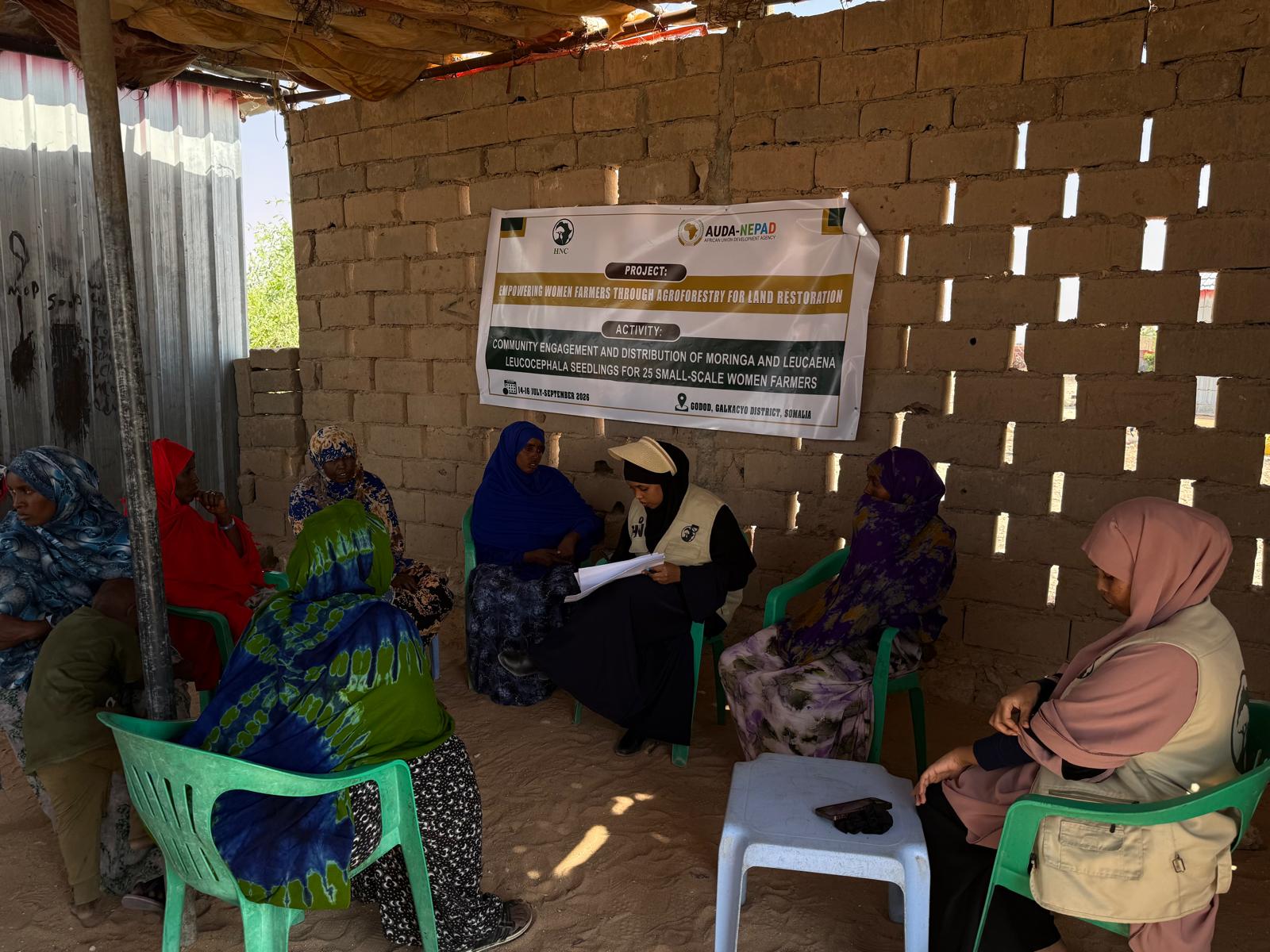
HNC's agroforestry training has distributed Moringa and Leucaena seedlings to farming communities whose soil had been exhausted by years of drought and wind erosion. Fadumo, a farmer and HNC trainee, shares that before this program, her community's soils were exhausted and crops were damaged by strong winds. However, after training and seedling support, her farm became greener, more productive, and far more resilient to drought and birds began returning to the fields as the new trees grew. Beyond restoring soil fertility, agroforestry also reduces wind damage to crops and helps conserve moisture during dry spells, giving farmers a buffer against increasingly erratic weather.
Solar-Powered Irrigation
Diesel powered water pumps are expensive to run and unreliable for smallholder farmers, especially during drought when fuel prices tend to rise sharply. As a result, HNC's Agri Solar Water Resilience initiative in Galkacyo has installed 85 solar panels, replacing costly diesel systems with clean, sustainable irrigation. This shift not only reduces ongoing costs for farmers but also protects water access during the driest months of the year, when reliable irrigation matters most.
Farmer Cooperatives
HNC helped establish the Danwadaag Agricultural Cooperative, now the largest farmers' cooperative in the Mudug Region. Mohamed, the cooperative's chairman, explains that before this support, farmers had no way to access opportunities or resources together. Today, the cooperative runs solar-powered irrigation for 11 shallow wells, freeing farmers from costly diesel pumps for good. HNC guided the cooperative through every stage of formation from developing bylaws and registering the organization to opening its first financial account giving farmers a stronger collective voice in accessing future support.
3. Key Approaches Behind HNC's Climate Adaptation Work
Training First, Tools Second
Communities are trained in techniques like agroforestry and sustainable land management before any equipment or seedlings are distributed, so that knowledge remains within the community long after a project officially ends. This sequencing matters: tools without training are quickly misused or abandoned, while trained communities can adapt techniques to new challenges as they arise.
Women Centered Programs
HNC prioritizes including women in agroforestry, cooperative-building, and livelihood programs, since women are often the most affected by resource scarcity and food insecurity. Supporting women's participation in these programs strengthens household resilience overall, as women frequently manage food production and resource allocation at the family level.
Strong Partnerships
HNC works alongside Somalia's and Puntland's Ministries of Environment and Climate Change, along with partners such as UNDP, FAO, WFP, IUCN, and UNCCD, ensuring programs align with national and regional climate strategies rather than operating in isolation. These partnerships also connect local communities to broader networks of technical expertise and funding opportunities that would otherwise be difficult to access independently.
Long Term Relationships Over One-Time Aid
Unlike short term relief efforts, HNC builds relationships designed to grow over time. Cooperatives like Danwadaag continue expanding their operations years after initial formation, taking on new projects and reaching more farmers proof that community based adaptation, when properly supported, becomes self-sustaining rather than dependent on continuous outside intervention.
Conclusion
Climate change adaptation for communities is not a single project or a one-time donation it is an ongoing partnership between organizations like Horn Nature Conservation and the people who live on the frontlines of a changing climate. From restoring degraded land to installing solar powered irrigation for farming cooperatives, HNC's work shows that when communities are given the right training, tools, and support, they don't just survive climate change they build lasting resilience against it. Every hectare restored, every seedling planted, and every farmer trained is part of a larger story: local communities in Puntland and across Somalia leading their own solutions to one of the world's most urgent challenges, one program and one partnership at a time.
Frequently Asked Questions (FAQs)
1. What is climate change adaptation for communities?
Practical steps like agroforestry, water management, and solar irrigation that help communities cope with and recover from climate change effects.
2. Why is community led adaptation more effective than large-scale projects?
Because communities know their own land and challenges best, so solutions are more likely to last long-term.
3. How does HNC choose which communities to work with?
HNC prioritizes communities facing the most severe drought, water scarcity, and land degradation, particularly across Puntland and the Mudug region.
4. Can individuals or organizations support this work?
Yes. Donors can support ongoing projects like the Garacad Mangrove Restoration Programme and the Agri Solar Water Resilience initiative.
5. What makes HNC's approach different from other environmental organizations?
HNC combines environmental restoration with direct livelihood support, so communities gain lasting skills, not just short-term aid.
6. How many communities has HNC reached so far?
HNC has reached 75 communities across Puntland and Somalia through its various programs.
7. Does HNC's work focus only on farmers?
No. HNC also supports pastoralists, women's groups, coastal fishing communities, and youth through its broader programs.
8. What role do women play in HNC's programs?
Women are prioritized in agroforestry, cooperative building, and livelihood training, since they are often most affected by resource scarcity.
9. How does solar-powered irrigation help farmers adapt to climate change?
It replaces expensive, unreliable diesel pumps with clean energy, protecting water access even during drought.
10. Why is mangrove restoration important for climate adaptation?
Mangroves protect coastlines from erosion and storm surges while supporting fisheries that coastal communities depend on.
Watch on YouTube
Field updates and community stories from Horn Nature Conservation.
Watch Horn Nature Conservation on YouTube for field updates and community stories.
Open YouTube Channelhttps://www.youtube.com/@Hornnature1
Related Articles
Horn Nature Conservation Distributes 500 Agroforestry Seedlings to Women Farmers in Galkacyo to Advance Landscape Restoration
HNC, with the Ministry of Environment and Climate Change of Puntland and AUDA-NEPAD AFR100 support, distributed 500 Moringa and Le...
Read more
How to Reduce Water Waste in Agriculture: Practical Strategies
Learn how to reduce water waste in agriculture with practical strategies including drip irrigation, soil moisture monitoring, mulc...
Read more
Water Conservation Methods in Agriculture: 10 Effective Ways to Save Water
Discover 10 practical water conservation methods in agriculture, from drip irrigation to rainwater harvesting, to cut water waste,...
Read more